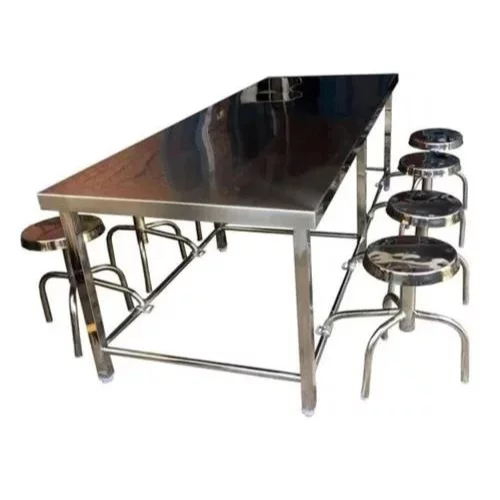
My grandmother had a steel dining table. It wasn't pretty — thick, heavy, slightly yellowed around the edges — but it survived three decades of daily use, two house moves, and approximately ten thousand meals without complaint. We eventually replaced it with something that looked nicer. Within four years, that "nicer" table was warped, the laminate was peeling at the corners, and we were shopping again.
I think about that a lot whenever someone tells me stainless steel dining tables feel too industrial for a home.
They're not wrong about the history. For a long time, SS dining tables were hospital canteen furniture — functional, utilitarian, cold. But what's happening with them in 2026 is genuinely different. The material hasn't changed. The design around it has.
Why This Trend Is Actually Happening
Walk into a well-put-together home in Delhi, Pune, or Bengaluru right now, and there's a real chance the centrepiece of the dining room is steel. Not because the owner is trying to look industrial — but because the table looks right against warm-toned walls, wooden chairs, and the pendant lighting above it.
Interior designers have been quietly steering toward this for a couple of years. There's a broader shift in how people think about metal in living spaces. The cold, clinical association is fading. What's replacing it is something more considered — steel paired with linen, warm wood, handmade ceramics, soft lighting. The contrast is the point. The steel gives the room its edge; everything around it softens it.
But honestly, aesthetics alone don't explain the sales numbers. What's really driving people toward stainless steel dining tables is something more practical: they're exhausted from maintaining everything else.
A wooden table in an Indian home is a commitment. Turmeric stains, humidity warping, water rings, re-polishing schedules. Engineered wood looks fine on day one and starts telling its story around year three. Glass requires constant wiping and one bad knock away from a bad evening. People have done the math — not formally, but experientially — and steel is coming out ahead.
What Steel Actually Does That Other Materials Don't
Before we get into looks and styling, it's worth understanding what you're actually buying — because the practical side of a stainless steel dining table is where the real argument lives.
It doesn't react to your kitchen. Place a hot serving dish straight from the stove onto a steel top. Nothing happens. No scorch mark, no bubbling finish, no ring you're trying to hide under a tablemat for the next five years. For Indian meals — where five things come out hot at the same time — this is not a small thing.
Cleaning is almost insultingly easy. Steel is non-porous, which means it doesn't hold onto stains, moisture, or bacteria. Haldi, masala, oil, spilled chai — wipe it with a damp cloth and it's done. There's no finish to baby, no grain to get food stuck in, nothing that starts smelling if you're not thorough enough.
The climate doesn't bother it. This is the part that matters most for India specifically. Monsoon humidity that swells wooden joints, coastal salt air that corrodes ordinary metals, the dry heat that cracks surfaces — 304-grade stainless steel shrugs at all of it. The chromium in the alloy forms a self-repairing protective layer that keeps rust away without any treatment on your end.
It genuinely lasts. Not five years, not ten. A properly made SS dining table — real 304 grade, decent gauge, well-welded — will outlast most of the other furniture in your house. Thirty years isn't unusual. When you divide the price by that lifespan, it's often the cheapest option in the room.
The Styles Available Now (It's Not Just a Rectangle)
Here's where most people are surprised. The assumption is that a stainless steel dining table looks one way — four legs, flat top, institutional. That was true fifteen years ago. It isn't now.
Full steel, brushed finish. The cleanest look. The entire table — top and frame — is steel, finished with a brushed texture rather than a mirror polish. This is the one that photographs beautifully and also happens to hide fingerprints, minor scratches, and the evidence of daily use far better than anything shiny. Works best in contemporary and minimalist homes.
SS frame, glass top. A steel base with tempered glass resting on top. This is popular in smaller apartments because the glass reads as visually light — you can see through to the floor, the room doesn't feel divided. The steel does the structural work; the glass keeps it from feeling heavy. One important note: it must be tempered glass. Regular glass has no business being a dining table top.
SS frame, wood top. This is the combination getting the most attention from designers right now, and it earns it. A cool brushed-steel base with a warm wooden top — sheesham, teak, walnut, oak — hits a balance that neither material achieves alone. It looks like a choice, not a compromise. The steel keeps it grounded and modern; the wood stops it from feeling like a workspace.
PVD-coated. PVD is a process where colour is bonded directly to the steel surface at a molecular level. Gold, rose gold, matte black, gunmetal. The result looks like a luxury finish but behaves like steel — it won't peel, chip, or fade the way paint does. A PVD gold SS dining table with velvet chairs around it is doing something that marble tables costing twice as much struggle to match.
Styling It So It Feels Like a Home, Not a Showroom
The question everyone asks: how do I make it look warm? Because that's the legitimate concern. Stainless steel under bad lighting, with mismatched chairs, in a room that hasn't been thought about — that looks cold. Here's how to avoid it.
Start with the chairs. This is the decision that changes everything. A brushed steel table surrounded by upholstered chairs — velvet, fabric, even a textured weave — immediately shifts the feel of the whole setup. The contrast does the work. The steel gives you the edge; the fabric gives people somewhere comfortable to sit. If you prefer wood chairs, stay with mid-tones. Oak and walnut sit well against steel. Very pale wood disappears; very dark wood makes the whole thing feel heavy.
Don't overthink the table surface. A simple linen runner down the middle. A ceramic vase. A wooden bowl with fruit. That's enough. You don't need to cover the table — it's a good-looking surface, let it be visible. What you need is one or two natural-texture elements to break the uniformity. Handmade ceramics work particularly well against the precision of steel.
Fix the lighting first, not last. This is where people go wrong most often. An SS dining table under a harsh white tube light looks terrible. The same table under a warm-toned pendant hung 70–80 cm above the surface looks genuinely beautiful. Steel reflects light — the quality of the light it reflects is everything. Before you even think about chair colours or runners, figure out your lighting. A dimmer switch is also worth it; the difference between a bright lunch setup and a warm evening dinner is significant.
Let it stand without a theme. One of the best things about a steel table is its neutrality. It doesn't need a metallic theme built around it. You don't need to start buying chrome lamp stands and steel-framed art to make it work. It sits comfortably in a room with terracotta walls and rattan chairs just as well as it does in an all-white contemporary apartment. Don't over-coordinate. Trust the table to hold its own.
The Buying Checklist (What Actually Matters)
When you're comparing tables — online or in person — these are the details worth paying attention to:
Steel grade. Ask for 304. Not 202, not 201 — 304. It's the difference between an alloy that genuinely resists corrosion and one that will start showing rust in a humid climate within a few years. Cheaper tables cut costs here; it's not visible at purchase, but it shows up later.
Gauge (sheet thickness). For a dining table top, 18 gauge is a reasonable standard. Go thinner than 20 gauge and you'll feel it flex under pressure and dent more easily. The gauge also determines how substantial the table sounds and feels — which matters more than it might seem.
Finish. Brushed or matte finishes are more forgiving in daily life. Mirror polish looks remarkable in a catalogue photo. In your actual home, with actual people using it, it shows every fingerprint and water mark. If you have children, or the table gets regular use, brushed is the right call.
Welds. Turn the table over or look at the joints between legs and frame. Clean, smooth welds with no gaps or rough edges are what you want. Rough or uneven welds are the most honest signal of a table that's been made quickly with less care.
Size. Measure the room with chairs pulled out — not chairs pushed in. A 6-seater needs roughly 150–180 cm in length and 90 cm wide. Allow 60–70 cm of width per person. And the standard table height is 75–76 cm; your chairs should sit with 25–30 cm of clearance to the underside of the top. Small miscalculations here make every meal slightly uncomfortable.
Why Cronax Industries Is Worth a Look
If you've decided an SS dining table is where you're headed, Cronax Industries is one manufacturer that genuinely understands what they're making.
A lot of what gets sold as stainless steel furniture is assembled from lower-grade material, finished quickly, and sold on the assumption that most buyers won't know the difference until it's too late. Cronax works differently. Their tables are built with 304-grade steel as standard — not as an upgrade — and the finishing work shows. Welds are clean, surfaces are even, and the proportions are designed for actual Indian dining rooms rather than scaled from European templates that don't account for how we use the space.
They cover the range well: full-steel brushed tables for modern apartments, mixed-material options with glass or wood tops, and PVD-finished pieces for buyers who want something with more presence. They also do custom sizing, which solves a problem that comes up constantly — the space between a standard 6-seater and 8-seater, or a room that needs something a specific length to sit properly in it.
What they're particularly good at is understanding the actual conditions their furniture lives in. Indian homes aren't European showrooms. Humidity, heat, heavy use, frequent cleaning — Cronax builds for that version of daily life, not the idealised one.
If you're spending on a table that's meant to last, it's worth buying from someone who's thought about the same things you should be asking about.
Three Buying Mistakes That Are Easy to Avoid
Choosing mirror polish because it looks good in photos. It does. And then it lives in your house and shows every fingerprint, every drop of water, and every tiny scratch from a serving spoon. Go brushed unless the table is primarily decorative.
Ignoring the grade. 202 and 304 look identical in a listing. Ask directly, and if the seller can't confirm, that tells you something. The grade difference is why two tables at similar prices behave completely differently over a decade.
Buying without measuring chairs. Table height and chair height need to work together. Standard is 75–76 cm table height with 45–47 cm chair seat height. It sounds like a detail until you're eating at a table where the proportions are slightly off, and then every meal reminds you.
The Honest Summary
A stainless steel dining table is not the right choice for everyone. If you want the warmth and grain of solid wood, nothing replicates that. If you're drawn to the drama of marble, steel won't satisfy that either.
But if you want something that will genuinely hold up — through Indian summers and monsoons, through years of hot dishes and daily cleaning, through kids growing up and the table still being there when they leave — steel makes a compelling case. It doesn't ask much from you. It just sits there and does its job, decade after decade.
My grandmother's table eventually left because we thought we wanted something better-looking. We didn't. We just wanted something that still worked as well, but looked different. Turns out that's a harder combination to find than it sounds.
An SS dining table done right — right grade, right finish, right styling around it — gets you there without compromise.
Exploring options for your home? Cronax Industries offers a range of stainless steel dining tables built for Indian homes — including custom sizes. Worth a conversation before you commit.
Comments on “The Stainless Steel Dining Table Is Back — And This Time It Actually Belongs in Your Home”